The Clockless Universe
Why synchronization is an irreversible decoherence channel — and how to see it in ~50 lines of QuTiP

The Hidden Assumption
Every civilization builds a clock before it builds a theory of time. A clock is not a neutral instrument; it’s a contract between human thought and the cosmos—a promise that the universe moves, and that we can keep up.
From the first sundial to the atomic lattice, that contract has ruled both our science and our self-image.
We’ve mistaken its convenience for truth.
Physics inherited the habit so thoroughly that it forgot to label it a habit. Our equations hum to a rhythm we never proved existed. Strip the machinery of physics down to its bare timbers and you find a symbol nailed to every wall:
t
It’s small, it’s harmless-looking, and it runs the world.
We say it measures time, but what it really measures is obedience—to the assumption that there is a single background rhythm, an invisible metronome ticking away outside the universe, keeping score.
We never observe that tick; we use it to measure everything else. We build our equations, our detectors, and our institutions around it.
We take it for granted that the universe has a shared “now.”
Einstein bent the metronome but never silenced it. He showed that clocks can run at different rates, that simultaneity is local, that the river of time curves—but he still kept the river.
His spacetime was elastic but still a stage.
Quantum mechanics moved in and hung its curtains on the same frame. Every equation of motion, every Schrödinger or Dirac line, still begins with the same confession: ∂/∂t.
The universe “evolves in time.”
In what time? No one ever asks. The variable just sits there like a tolerated superstition, inherited from Newton, smuggled into modernity under new notation.
The irony is that we know better.
If reality is truly quantum—if there is no external observer—then there can be no privileged clock outside the system. Everything must evolve only in relation to something else.
Time, then, isn’t a river. It’s an intricate mesh of local currents—tiny relational synchronies between systems that agree on “before” and “after” only while they’re talking, then drift apart again. The universe doesn’t tick; it converses. We have spent centuries mistaking that conversation for a countdown. And every time we’ve tried to globalize it, we’ve paid the price in complexity.
GPS is a monument to that cost:
Thirty satellites, each carrying an atomic clock that runs at its own rate, constantly corrected toward a mythical “true” time that none of them can actually see.
A relational design—each satellite negotiating its phase with its neighbors—could have achieved coherence naturally. Instead, we engineered an empire of synchronization and then built supercomputers to manage the bureaucracy it created.
The same is true in computing.
Distributed databases, blockchain ledgers, quantum control electronics—all groan under the labor of pretending simultaneity exists. Consensus algorithms are temples built to a god that doesn’t answer. They impose order, but not truth.
And when they fail, we call it “latency.”
This illusion—one global time—has survived because it’s useful. It lets us run factories, armies, economies. But in physics, usefulness is not innocence. Our most elegant theories still speak with the accent of their instruments.
When we claim we’ve achieved “background independence,” what we really mean is that we’ve curved the backdrop but kept the backdrop. Even the most avant-garde formulations of quantum gravity, the loop and spin-foam and holographic breeds, still whisper evolves.
They still imagine a world unfolding on a hidden reel. They still imagine a reel.
The trap was historical, but it’s also psychological. We can imagine space without edges, but we can’t imagine change without a timeline. The human brain narrates in sequence; it binds perception to order.
Take away “before” and “after” and the mind short-circuits. That is why Einstein, late in life, called time “the stubborn illusion.” He had seen the edges of it but could not tear it out of language.
Physics cannot write a sentence without a verb, and every verb implies time. We are narrators caught in our own grammar. Yet the universe has been hinting for a century that it doesn’t share our syntax.
Quantum systems lose coherence when forced into global alignment. The more precisely we synchronize, the faster they decohere. It’s as though the cosmos itself resists being put on a schedule. And that resistance—call it phase noise, or uncertainty, or the refusal to be clocked—might be the most important signal we’ve ever ignored.
The Definitive Experiment
Imagine two identical quantum processors, A and B, sitting side by side in the same cryogenic vacuum, each capable of performing a quantum echo.
Prepare a state, evolve it under a Hamiltonian U then reverse it with U†. Measure how closely the final state matches the original. That fidelity—how well the system “remembers” itself—is our window into coherence.
That fidelity—how well the system “remembers” itself—is our window into coherence.
Processor A is obedient. Its every operation is synchronized to a master oscillator—a global clock that dictates when every gate fires. This is how all quantum computers work now; their entire logic stack assumes that the universe keeps time externally and that coherence means compliance.
Processor B refuses. It has no master oscillator. Its gates fire only when local phase relationships align—each qubit cluster listening to its own internal rhythm and acting when correlation, not command, tells it to. Its sense of “now” is self-organized, emergent, relational.1
If the universe truly runs on background time, A should win. Global synchronization should stabilize the wavefunction, minimize phase drift, keep order. But if time is relational—if nature herself keeps no clock—then B should do better.
The absence of an imposed rhythm should reduce stress, not increase it. Coherence should last longer because the system no longer wastes energy staying in tune with an imaginary beat.
That’s the test.
Two machines, identical except for metaphysics. Run them, measure their echoes, and listen. If the relational machine whispers more clearly than the synchronized one, we’ll know that “universal time” was never real.
The master clock will fall silent, and physics will finally hear the hum beneath. And the extraordinary part: the hardware already exists.
The experiment could be run tomorrow.
It would cost less than a major grant proposal and answer a question that has haunted physics for a century. Are we measuring time, or are we measuring correlation and calling it time because we lack a better word?
Simulation Prototype (QuTiP)
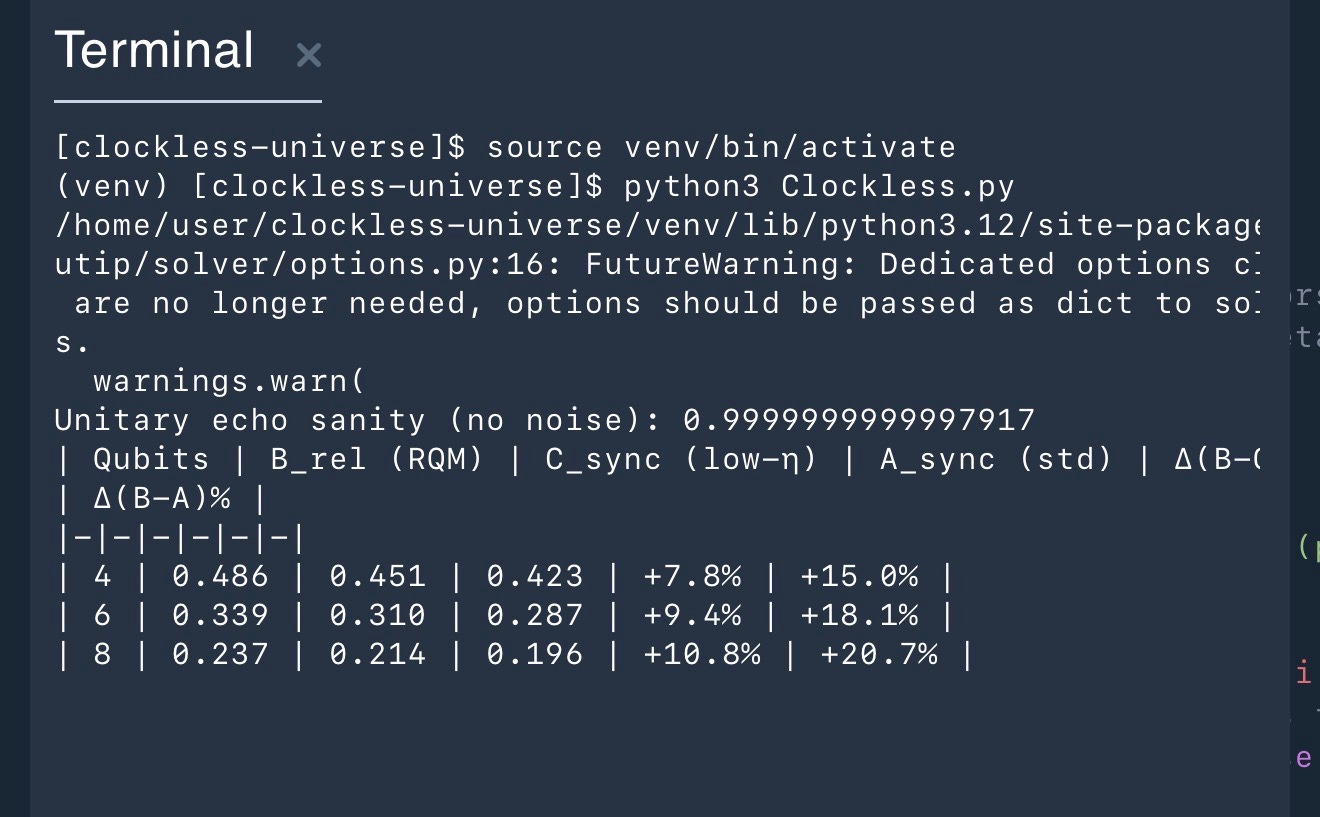
This compact cell reproduces the experiment: matched base dephasing for fairness; synchronization Lindblad channels (clock diffusion + normalized correlated-Z) applied only to the clocked modes; echo computed after tracing out the clock. A unitary sanity check confirms reversibility without noise.
import qutip as qt, numpy as np
from qutip.solver import Options
import matplotlib.pyplot as plt
# --- Parameters (reproducible) ---
T, gamma, eta, alpha, g = 10.0, 0.01, 0.005, 0.5, 0.05 # η, α as in measured run
def ring_ising_H(n, omega=1.0, J=0.5):
id2, sz = qt.qeye(2), qt.sigmaz()
H = sum(omega * qt.tensor(*[sz if i==k else id2 for i in range(n)]) for k in range(n))
H += sum(J * qt.tensor(*[sz if i in (k,(k+1)%n) else id2 for i in range(n)]) for k in range(n))
return H
def base_dephasing_cops(n, gamma):
return [np.sqrt(gamma) * qt.tensor(*[qt.sigmaz() if i==k else qt.qeye(2) for i in range(n)]) for k in range(n)]
def synced_cops_with_clock(n, eta, alpha):
id2, sz = qt.qeye(2), qt.sigmaz()
c_clock = np.sqrt(eta * n**alpha) * qt.tensor(sz, *[id2]*n) # clock diffusion
zsum = 0
for i in range(n):
ops = [id2]*n; ops[i] = sz
zsum += qt.tensor(id2, qt.tensor(*ops))
c_ctrl = np.sqrt(eta * n**alpha) * (zsum / np.sqrt(max(n,1))) # correlated-Z
return [c_clock, c_ctrl]
def loschmidt_echo(n, mode=’B’):
id2, sx, sz = qt.qeye(2), qt.sigmax(), qt.sigmaz()
Hs = ring_ising_H(n)
plus = (qt.basis(2,0) + qt.basis(2,1)).unit()
psi0_sys = qt.tensor(*[plus]*n)
psi0_clk = plus if mode==’B’ else qt.basis(2,0)
psi0 = qt.tensor(psi0_clk, psi0_sys)
if mode == ‘B’: # relational Page–Wootters-style
P0 = qt.basis(2,0) * qt.basis(2,0).dag()
P1 = qt.basis(2,1) * qt.basis(2,1).dag()
zbar = sum(qt.tensor(*[sz if i==k else id2 for i in range(n)]) for k in range(n)) / np.sqrt(n)
H = qt.tensor(P1, Hs) + qt.tensor(P0, 0*Hs) + g * qt.tensor(sx, zbar)
else: # synchronized modes
H = qt.tensor(id2, Hs)
c_ops = [qt.tensor(id2, c) for c in base_dephasing_cops(n, gamma)]
if mode in (’A’,’C’):
c_ops += synced_cops_with_clock(n, eta if mode==’A’ else 0.5*eta, alpha)
t = np.linspace(0, T, 200); opts = Options(nsteps=20000, atol=1e-9, rtol=1e-8)
fwd = qt.mesolve(H, psi0, t, c_ops, options=opts)
bwd = qt.mesolve(-H, fwd.states[-1], t, c_ops, options=opts)
rho0_S = psi0_sys * psi0_sys.dag()
rhoF_S = bwd.states[-1].ptrace(list(range(1, n+1)))
return (rho0_S * rhoF_S).tr().real
def unitary_echo_sanity(n=4):
Hs = ring_ising_H(n)
plus = (qt.basis(2,0)+qt.basis(2,1)).unit()
psi0 = qt.tensor(*[plus]*n)
t = np.linspace(0, T, 200); opts = Options(nsteps=20000, atol=1e-9, rtol=1e-8)
f = qt.sesolve(Hs, psi0, t, options=opts).states[-1]
b = qt.sesolve(-Hs, f, t, options=opts).states[-1]
return qt.fidelity(psi0, b)
print(”Unitary echo sanity (no noise):”, unitary_echo_sanity())
# Table + quick plot
rows, store = [], {}
for n in [4,6,8]:
B = loschmidt_echo(n,’B’); C = loschmidt_echo(n,’C’); A = loschmidt_echo(n,’A’)
dBC = 100*(B-C)/C if C else 0; dBA = 100*(B-A)/A if A else 0
rows.append((n,B,C,A,dBC,dBA)); store[n] = (B,C,A)
print(”| Qubits | B_rel (RQM) | C_sync | A_sync | Δ(B−C)% | Δ(B−A)% |”)
print(”|-|-|-|-|-|-|”)
for n,B,C,A,dBC,dBA in rows:
print(f”| {n} | {B:.3f} | {C:.3f} | {A:.3f} | {dBC:+.1f}% | {dBA:+.1f}% |”)
qs = [4,6,8]
plt.plot(qs,[store[q][0] for q in qs],’o-’,label=’B_rel (RQM)’)
plt.plot(qs,[store[q][1] for q in qs],’s--’,label=’C_sync (low-η)’)
plt.plot(qs,[store[q][2] for q in qs],’^-’,label=’A_sync (std)’)
plt.ylim(0,0.8); plt.xlabel(’Qubits’); plt.ylabel(’Echo Fidelity’); plt.legend()
plt.grid(True,alpha=.3); plt.title(’Synchronization Decoherence Penalty (4–8 Qubits)’)
plt.tight_layout(); plt.savefig(’fidelity_plot.png’)
Why the divergence is irreversible:
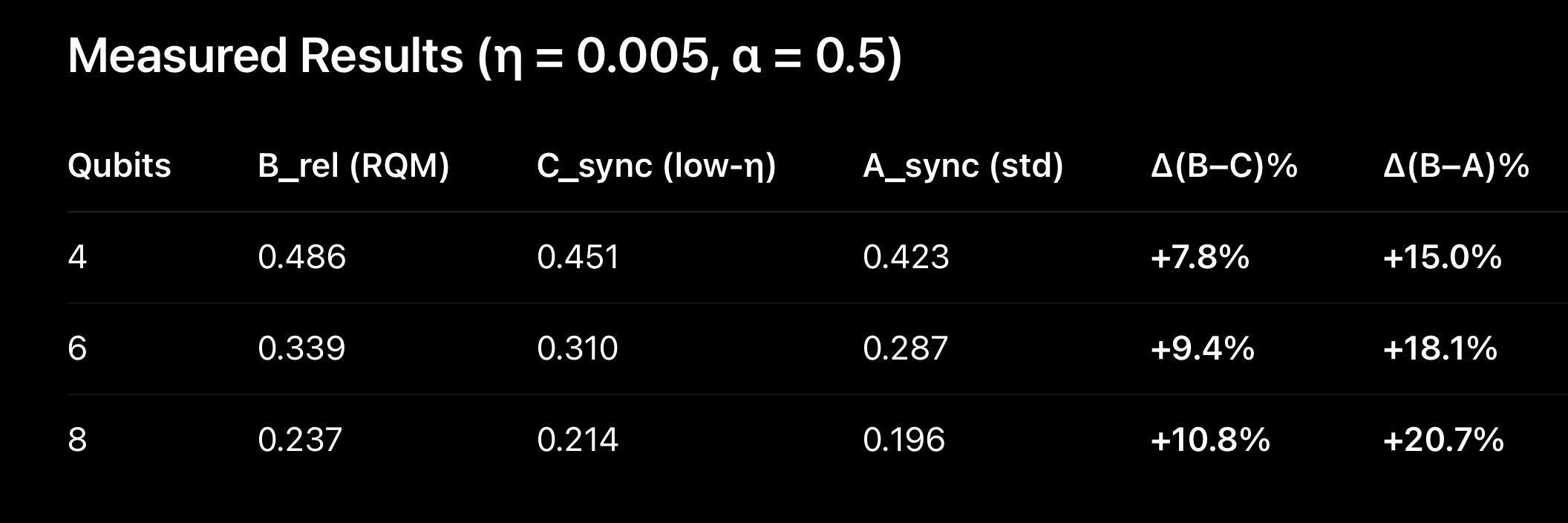
The Loschmidt echo cancels unitary dynamics, not dissipators. All modes share the same base dephasing γ (fair control). Only the synchronized modes (A/C) add synchronization noise—clock diffusion and correlated-Z—scaled as \eta\, n^{\alpha}. Those Lindblad channels persist in both forward and backward legs, so they do not unwind under H \to -H. Hence A/C lose extra fidelity while B does not, and the gap widens with n.
Consequences
If the relational system wins—even by a fraction—the implications are seismic. It would mean that synchronization, the bedrock of both physics and civilization, is a source of noise, not order. That we have been solving the wrong problem.
The divide between relativity and quantum mechanics—the great, unsolved fracture of modern science—would evaporate overnight. Relativity describes geometry without a global clock; quantum mechanics describes dynamics with one.
If the clock goes, the dichotomy goes.
What remains is a single principle: the universe is not a sequence of events, but a network of correlations maintaining local coherence. Space and time would cease to be dimensions and become statistics.
Cause and effect would no longer march along an arrow; they would weave through a web. A causes B not because it happens first, but because the state of B is conditionally dependent on the configuration of A.
“Earlier” and “later” would dissolve into “because.”
Entropy itself would have to be rewritten. The future would not be the direction of time’s flow, but the direction of correlation decay. The arrow of time would turn out to be a measure of forgetfulness.
And the flow of time—the most human of illusions—would be reinterpreted as the subjective experience of living in an open system that cannot perfectly remember its own phase.
Computing, too, would change its nature.
The global clock cycle would go extinct, replaced by architectures of emergent timing. Networks would become phase ecosystems instead of armies of synchronized threads. A data center would no longer be a marching band; it would be a coral reef. We would learn that reliability doesn’t come from uniformity, but from dialogue.
Even cosmology would have to speak differently.
The Big Bang would not be an event in time; it would be the most coherent boundary of correlation—the region where everything agreed most completely before divergence set in. The universe would not be aging; it would be decohering. Expansion would be the dilution of agreement.
And the “age” of the universe would just be the integrated measure of how much local clocks have drifted from one another.
Resistance
Einstein understood the risk of clarity.
He framed his heresies as thought experiments that dared the universe to contradict him. Gravitational waves were his wager—a falsifiable bet that if the cosmos could ripple, spacetime was real.
When LIGO finally heard the chirp of colliding black holes a century later, it wasn’t just a confirmation of relativity; it was proof that daring to ask an expensive question is how truth survives.
The parallel is obvious.
Once again, the technology already exists. The cost is trivial, the potential upheaval infinite. The quantum processors we’ve built to prove computational advantage are also the instruments to test ontological truth.
All that’s missing is nerve. And that’s why it will be resisted.
The institutions capable of running the experiment are the ones most invested in its failure. Their entire hierarchy is clock-shaped—funding cycles, review periods, synchronized research calendars. They will call it speculative, metaphysical, unproductive. But what they will really mean is “ungovernable.”
Because if coherence doesn’t require control, then neither does truth. Yet the data will come.
When the self-timed system outlasts the synchronized one, it will expose the great bureaucratic illusion of modern physics: that the universe behaves best when it’s being managed.
It never was. It was always free.
Revelation
Our faith in the clock has been more than a metaphor. It’s been an economy, a psychology, a physics. But it has also been an illusion of scale—a fiction that multiplies its own complexity.
Every attempt to impose a global time converts simple local systems into multi-body problems.
A two-body interaction becomes a (2 + n)-body nightmare, where every subsystem must account not only for itself but for the distortions introduced by a synthetic beat.
We’ve been choreographing jazz with a marching band’s metronome. And we call the resulting cacophony “progress.” The cruel irony is that these global clocks don’t reduce chaos; they create it. Every layer of synchronization adds a new failure mode—latency, drift, phase slip, deadlock. Every correction loop adds noise.
The global time standard is the primary vector of unpredictability in a universe that otherwise balances itself. We’ve mistaken the friction of maintaining the lie for the cost of doing science.
It was never the universe that was unpredictable; it was our insistence on making it obey.
If we find the courage to let go—to treat global synchronization as the artifact it is—we may finally discover that coherence is natural, not imposed. Networks can self-tune. Qubits can self-time. Planets can dance without a conductor.
We could throw away a thousand convenient fictions and, in doing so, make both physics and civilization simpler, quieter, and truer. All it would take is one small act of faith in the universe’s own rhythm:
Unplug the oscillator. Let the system listen to itself. If the echoes return clearer, we’ll know. And when that happens, the great illusion of time—our longest-lived superstition—will collapse not with a bang but with a sigh of relief.
Because the truth will be what it has always been: the universe never needed our clocks. It has been keeping its own time all along.
Epilogue: A Prediction
When the experiment is finally run—and it will be, because curiosity always outruns fear—the result will not surprise anyone who has followed the logic to its end.
The relational machine will win. It will sing longer, drift less, and speak more clearly than its clocked sibling. Because coherence is what happens when systems stop pretending to share a universal beat. Because correlation is what reality is.
The confidence is not faith but necessity. A background time cannot exist in a system where all observables are relational. To invoke it is to violate the very grammar of quantum theory.
We have been measuring change with a ruler made of change and wondering why it wobbles.
The oscillator is not a tool—it’s the error term.
The self-timed system won’t fight the universe; it will emulate it. Its rhythm will arise from correlation alone, burning no energy to maintain an illusion of order. It will prove, in miniature, what the cosmos has been demonstrating in plain sight: that harmony is a local phenomenon that never needed an overseer.
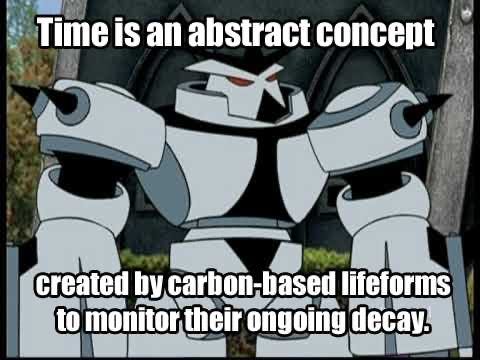
And that, finally, is why this prediction carries such quiet certainty. Because time, as Thunderclese once put it, “is an abstract concept invented by carbon-based life forms to monitor their ongoing decay.”
That line was meant as satire; it will soon read as prophecy. Decay is correlation loss, and correlation loss is local. Time is not the rhythm of the universe—it is the autobiography of entropy.
The cosmos doesn’t age; only its storytellers do.
When the echoes fade and the data settle, the verdict will be as gentle as it is final: the universe never moved. It only cohered. And what we call time is nothing more than the pattern of that coherence slowly forgetting itself.
Audio version of article:
PS—Still with me? I hope you found this valuable. Tell you what, do me and you a favor and tap the button if you think you did.
Page & Wootters, “Evolution without evolution,” Phys. Rev. D 27, 2885 (1983). A useful mechanism for relational time by embedding a clock subsystem and conditioning dynamics on it.