A Modest Proposal
For finally making elections fair.

I have become convinced that nearly every controversy concerning elections proceeds from an unnecessary and frankly antiquated distinction.
We permit campaigns to do almost anything imaginable in order to produce votes.
They may spend billions of dollars.
They may employ armies of consultants.
They may discover that suburban women between the ages of thirty-eight and forty-four become 0.7 percent more persuadable when shown a golden retriever beside a kitchen island.
They may knock on your door, call your telephone, fill your mailbox, occupy your television, purchase your search results, infiltrate your breakfast cereal, and dispatch a highly trained volunteer to remind you that democracy itself may die unless you leave work early and stand inside a middle-school gymnasium.
They may flatter you, frighten you, inspire you, shame you, transport you, register you, harvest your attention, model your personality, and optimize the exact shade of blue most likely to activate your latent civic concern.
All of this is considered campaigning.
But after applying this immense machine to the human population, we suddenly become sentimental.
At the final moment, we insist that each additional vote must pass through an additional person.
Why?
What useful work is this person performing?
The campaign has already identified the preference, induced the preference, reinforced the preference, transported the preference, reminded the preference, and in many cases supplied the preference with a preprinted guide explaining exactly how the preference should express itself.
The voter has become the final mechanical relay in a vast political apparatus.
Yet for reasons no one can adequately explain without invoking a cloud of sacred nouns, we still require one warm body per unit of electoral output.
I propose that we eliminate this bottleneck.
Let us take the filter off.
Let every citizen cast as many votes as he can devise, manufacture, solicit, finance, automate, duplicate, improvise, or otherwise cause to appear before the polls close.
No ballot shall be rejected merely because another ballot resembles it.
No voter shall be suppressed merely because he has already voted.
No expression of democratic will shall be disenfranchised merely because it emerged from a printer at industrial speed.
The polls shall open at six in the morning.
They shall close at seven in the evening.
Between those hours, go bananas.
Every method is valid.
Every machine is welcome.
Every loophole is simply an underutilized avenue of civic participation.
Election Day will become what it has always secretly wanted to be: a national hackathon with flags.
The winner will be the candidate whose supporters can generate the greatest number of ballots before the clock expires.
This system has several obvious advantages.
First, it resolves the interminable dispute over voting rights.
Everyone has the same right.
You may vote once.
You may vote twice.
You may vote seven million times.
Your only limitation is your imagination, your stamina, your access to office equipment, your command of distributed systems, and the number of cousins willing to spend twelve hours feeding envelopes into a converted agricultural hopper.
This is equality in its purest form.
Not equality of outcome, certainly.
Not equality of equipment.
Not equality of technical competence.
But equality of permission.
The law shall stand before the billionaire, the software engineer, the church choir, the labor union, the neighborhood association, and the retired gentleman with an unusually fast photocopier and declare:
You are all equally free to win.
Second, this system resolves the question of election legitimacy.
At present, whenever a candidate wins, half the country immediately begins asking whether the result truly represents the will of the people.
Under my proposal, this question becomes unnecessary.
The winner received the most votes.
What clearer evidence of legitimacy could there be?
A critic may object that many of these votes were manufactured by a very small number of people.
But this objection merely reveals an attachment to the old and discriminatory doctrine that votes ought to be associated with voters.
We must progress beyond such primitive person-centered thinking.
A vote is a vote.
Its origin should no more concern us than the origin of a dollar deposited into a bank account.
Once counted, it has joined the democratic total.
To interrogate its ancestry would be unseemly.
We do not ask a raindrop whether it fell freely.
We measure the flood.
Third, my system will dramatically reduce accusations of fraud.
This is because fraud will no longer exist.
Fraud is merely a name we give to highly motivated political participation that has crossed an invisible procedural boundary.
Remove the boundary and the moral confusion evaporates.
A supporter who produces one ballot is a voter.
A supporter who produces ten thousand ballots is an organizer.
A supporter who discovers a database synchronization error that produces forty million ballots is a movement.
The public will no longer endure months of litigation concerning whether some campaign improperly exploited a voting system.
Improperly?
The whole point is to exploit the voting system.
That is the competition.
We shall print this directly on the ballot instructions.
EXPLOIT RESPONSIBLY.
Fourth, election campaigns will become more honest.
Candidates currently speak in the language of representation.
They claim to embody the hopes of farmers, teachers, workers, parents, children, small businesses, large businesses, minorities, majorities, future generations, previous generations, and several abstract entities incapable of voting but apparently rich in endorsements.
Under my proposal, a campaign need make only one claim:
We believe we can produce more ballots than the other side.
This is wonderfully testable.
No more vague appeals to the soul of the nation.
No more rhetorical hallucinations about mandates.
No more candidate standing before thirty-seven percent of the eligible electorate and announcing that America has spoken with one voice.
America has never spoken with one voice.
America has spoken through several hundred million people, many of whom were eating dinner and did not answer the question.
My system makes no such metaphysical claims.
It measures exactly what it measures.
Coalition ballot-production capacity under a fixed closing time.
Clean.
Finite.
Auditable.
For the first time in political history, the number on the screen would mean precisely what it says.
Some will fear that the wealthiest and most powerful coalition would always win.
This concern is understandable, but probably overstated.
The wealthiest and most powerful coalition usually wins already.
Money purchases advertisements.
Advertisements purchase attention.
Attention purchases persuasion.
Persuasion purchases turnout.
Turnout purchases votes.
We are merely shortening the supply chain.
Instead of converting money into consultants, consultants into messaging, messaging into human behavior, and human behavior into ballots, money may now be converted into ballots directly.
Think of the efficiency.
The same organizations will possess the same advantages.
Large donor networks will fund large ballot operations.
Universities will develop interdisciplinary programs in electoral fabrication.
Campaign headquarters will replace phone banks with ballot foundries.
Cable news will display real-time estimates of national vote-manufacturing capacity.
Experts will explain that one party has a strong advantage in ink logistics, while the other has made surprising gains among owners of high-throughput document scanners.
Election coverage will become useful.
Naturally, there will be occasional upsets.
Any sufficiently open system eventually encounters three unusually determined teenagers in a garage.
One year, a whiz-kid team may discover that a rural county’s tabulation server interprets a certain barcode as the integer maximum.
They will then install their roommate as governor with a natural coalition consisting of themselves, the roommate, and the roommate’s aunt, who thought she was signing up for a streaming service.
This will be described as a stunning grassroots realignment.
Political scientists will spend four years explaining how Kevin captured the overlooked garage demographic.
Journalists will travel to his neighborhood and interview a bewildered man carrying groceries.
Documentaries will be produced.
Books will be written.
One will be titled THE KEVIN VOTER.
The republic will survive.
Indeed, Kevin may prove no worse than the normal candidates, having at least demonstrated competence in selecting friends.
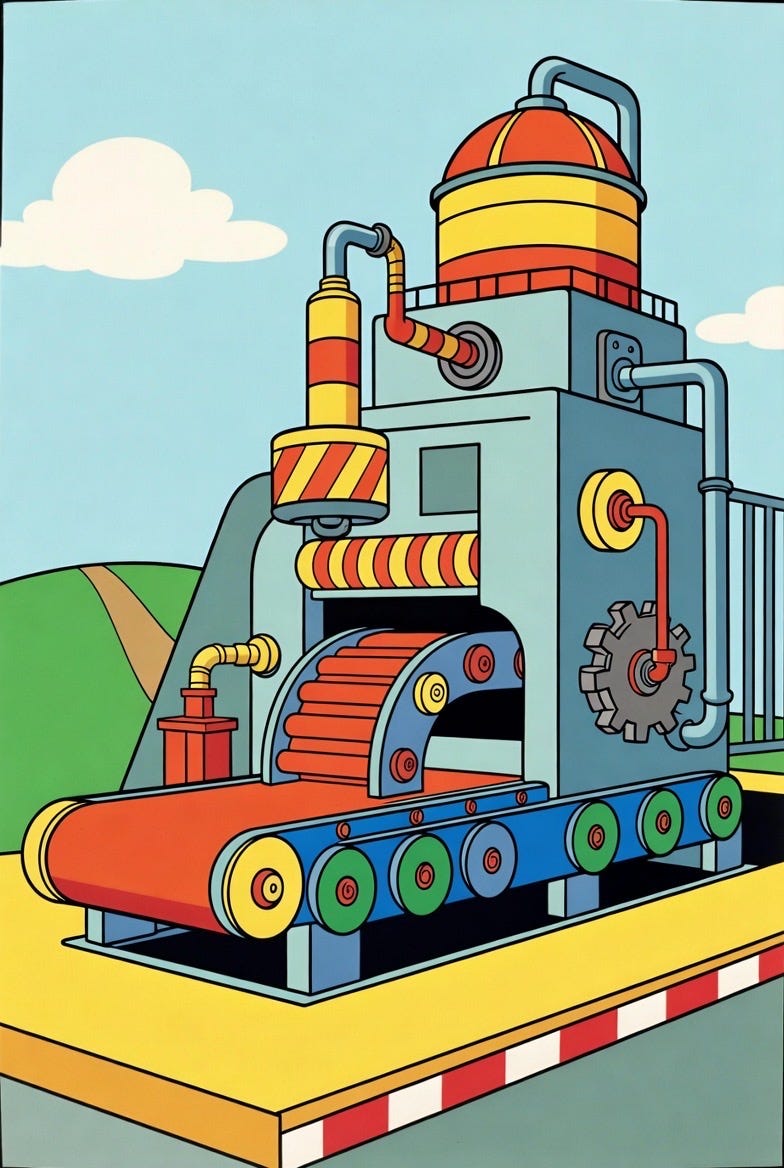
The deeper beauty of the system is that campaigning will no longer be separated from voting by an arbitrary membrane.
At present, campaigns may multiply influence but may not multiply electoral weight directly.
They may produce supporters, but not merely produce votes.
They must route every unit of counted power through a distinct human authorization.
This is inefficient and philosophically incoherent.
Suppose a campaign volunteer persuades one hundred people to vote.
We celebrate him.
Suppose he saves time and fills out one hundred ballots himself.
We imprison him.
Yet in both cases, one motivated person has caused one hundred votes to enter the count.
The only difference is that in the first case he had to operate one hundred biological intermediaries.
Why should political legitimacy depend upon the campaign’s willingness to complete this elaborate human CAPTCHA?
The voter is simply the proof-of-personhood token presently demanded by the system.
I propose proof of work instead.
Let political power belong to those who can demonstrably produce it.
A coalition with a million passive supporters should lose to a coalition with twelve supporters and an extraordinary printer.
This is not a defect.
It is the revealed preference of the electorate, where “electorate” is properly understood to include machinery, paper, software, logistics, caffeine, and anyone clever enough to understand the assignment.
The old slogan was one person, one vote.
The new slogan shall be more inclusive:
One person, as many votes as his imagination can instantiate.
At last, political enthusiasm will possess no artificial ceiling.
The deeply committed citizen will no longer be told that his seven-thousandth vote matters less merely because he has already expressed the same conviction six thousand nine hundred and ninety-nine times.
What cruel theory of democracy says intensity should not count?
Why should the mildly supportive citizen possess the same electoral weight as the citizen who has rented a warehouse?
My proposal recognizes conviction in its material form.
Not what you say.
Not what you claim.
What you can cause to exist before seven o’clock.
There will, of course, remain questions of fairness.
Humanity can generate a fairness dispute from the seating arrangement at an empty table.
Citizens without printers will demand public printers.
Citizens with printers will argue that public printers distort the natural market in political expression.
One party will advocate universal ballot-production credits.
The other will insist that every citizen already possesses the opportunity to establish a shell corporation and negotiate a bulk paper contract.
Activists will argue that rural ballot factories face unfair shipping costs.
Congress will create a subsidy.
The subsidy will accidentally purchase several million votes for Guam.
But these arguments will be refreshingly concrete.
No one will need to pretend that elections measure some vaporous collective soul.
We will know what happened.
One side built a better vote machine.
The final count will not answer the question, “What did the people want?”
No election has ever answered that question perfectly.
It will answer a smaller and more honest question:
“What quantity of electoral output could each coalition cause to exist under the declared conditions?”
That is already much of what campaigns do.
We have simply preserved the machinery and removed the ceremonial requirement that each unit of output pause briefly inside a different person.
I therefore commend this reform to all who value democracy, innovation, participation, inclusion, disruption, optimization, institutional legitimacy, and reduced administrative overhead.
Open the polls.
Remove the limits.
Count everything.
Certify the largest number.
And when the losing side asks whether the result truly represents the will of the people, we shall answer with the serene confidence of a civilization that has finally escaped ambiguity:
Of course it does.
Look how many votes it got.